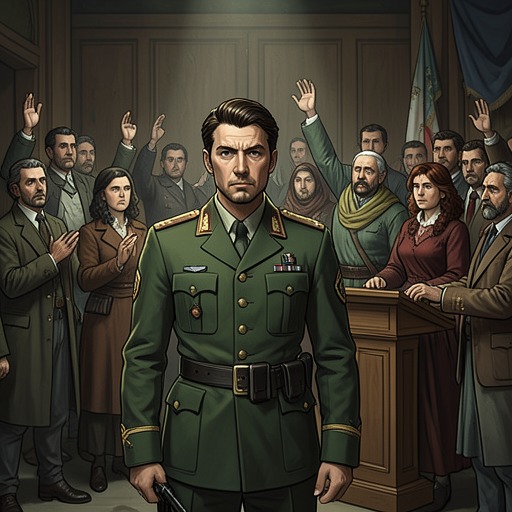
Italian Socialist Party Policy of Absolute Neutrality
M: Son of the CenturyThe Italian Socialist Party Policy of Absolute Neutrality set the party against Italy’s intervention in the First World War. Its importance in the book lies both in the position itself and in the rupture it exposed: Benito Mussolini, once a prominent socialist editor who could interpret the proletarian movement to its members, reversed course within weeks and made intervention the cause of a new political career.
The party position and Mussolini’s standing
Before the war, Mussolini had risen from obscure origins to a position of prominence within official socialism. From 1912 he edited Avanti!, the newspaper that guided the socialists, and was esteemed and loved in that role. The account emphasizes that former comrades continued to regard him as exceptionally able to understand and express the spirit of the proletariat. That standing makes his break with the party’s neutrality policy more than a disagreement between a leader and his organization: it is presented as a betrayal felt by people who had trusted his political judgment.
The policy opposed intervention in the conflict between the European powers. In October 1914, Mussolini argued instead for Italy’s active neutrality, departing from the party’s absolute-neutrality line. The distinction did not hold: within weeks, he became a fervent advocate of intervention. The speed and intensity of the reversal are central to the account’s presentation of the split.
From dissent to a new newspaper
On October 20, 1914, after taking a position against the leadership of the Italian Socialist Party over the war, Mussolini resigned as editor of Avanti!. On November 15 he began publishing Il Popolo d’Italia. In opposition to Avanti!, the new paper promoted intervention against the militarism of the Central Powers and attacked the former newspaper and its principal supporters in bitter controversy. The change was therefore organizational as well as ideological: Mussolini left the platform through which he had reached socialist readers and established a rival vehicle for his new position.
His former comrades accused him of moral and political unworthiness and expelled him. The policy of absolute neutrality thus became a boundary of party membership in this episode. Mussolini’s advocacy of intervention was not treated as a permissible difference within the organization; it ended his editorial role and his standing inside official socialism.
A disputed break with socialism
The account resists explaining the reversal simply as personal self-interest or a pursuit of gain. At the same time, it leaves open how far Mussolini’s socialist convictions were compromised by the financial arrangements needed to sustain Il Popolo d’Italia, his dealings with people and factions of differing views, and the hostility directed at him by former followers. These pressures are presented as part of the political circumstances surrounding his new course, not as proof of a single hidden motive.
Nor does the break settle his relation to socialism. The account says that Mussolini never publicly repudiated his socialist convictions and continued to want to appear socialist, perhaps persuading himself that he remained one. His departure from the party’s wartime policy is therefore portrayed as a decisive political rupture whose ideological meaning remained unsettled: the former editor could oppose the party and its neutrality line while retaining, or claiming to retain, a socialist identity.
The political afterlife of the rupture
Later episodes show Mussolini operating among political forces that his departure had placed in conflict with one another. In July 1920 he opposed the general strike and helped establish a hard line against the “red” agitators, even as he revived the prospect of a pre-electoral committee with the factions of left-wing interventionism. At a meeting in Milan, he proposed a social and economic reorganization centered on workers’ welfare but free of Bolshevik influence. The combination recalls the unresolved tension already visible in his departure from absolute neutrality: he sought new political alliances without simply erasing the language of social reform.
The surrounding state response further altered the political setting. Acting on Mussolini’s instructions, Michele Bianchi had reached an agreement with Milan’s prefect to make the fasci available for public-order duties. A confidential government circular then urged fascist collaboration in suppressing revolutionary attempts, including by violent means, provided the groups accepted official command. This later accommodation between the liberal state and the fascists does not define the Italian Socialist Party’s wartime policy; it shows how far the political landscape had shifted after the dispute that drove Mussolini out of official socialism. The policy’s lasting significance in the narrative is thus the line it marked between his former party allegiance and the interventionist politics through which he built a new base.